Excerpt from the MacMillan Center Council on Latin American and Iberian Studies (CLAIS) news, originally published on April 27, 2020 by Alison Kibbe, PhD Student in American Studies and African American Studies and Teanu Reid, PhD Candidate in History and African American Studies.
“Haiti is a site of dance ethnography that requires receptivity and humility.”
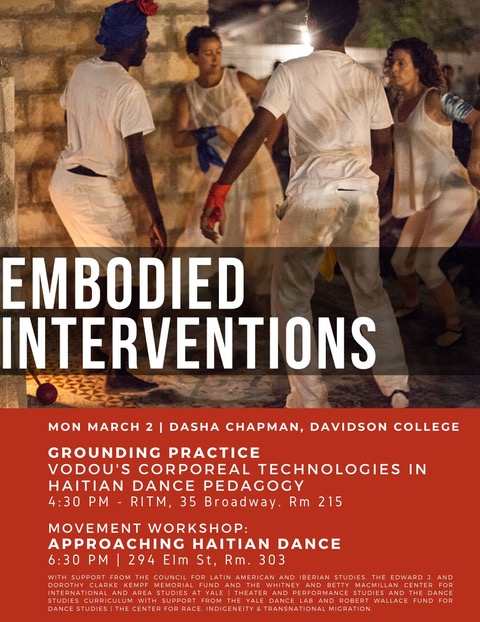
Dr. Dasha Chapman articulated, and then lead us through, this stance of receptive humility during her public talk and movement workshop on March 2nd. The second scholar in the Embodied Interventions series, Dr. Chapman gave a public talk titled “Grounding Practice: Vodou’s Corporeal Technologies in Haitian Dance Pedagogy” during which she shared her journey and research with, through, and about Haitian dance. Using interdisciplinary methods routed through Vodou epistemes and Africana theory, Dr. Chapman has spent the last decade working in community with dance artists on the island and in the diaspora. Her research and artistic work explores the connections between place, performance, and practice and the central role dance and collective movement in understanding Haiti’s past, present, and future.
…
Dr. Chapman states, Haitian dance practitioners “shepherd worlds that cannot take place without collective dance practice. Dance brings worlds into presence through embodied memory.” This came into focus as she explored the connections and overlaps between folkloric dance practitioners and gender/sexuality. By centering the creative and pedagogic practices of artists such as Jean Appolon – a Haitian dance artist who lives in the U.S. and teaches an annual summer institute in Haiti, and [what she terms] his Black queer feminist Haitian dance pedagogy – Dr. Chapman’s research explores how folkloric dance can “make space for movement that is both culturally meaningful and at times transgressive.” In the work of the dance artists with whom she collaborates, and in the Vodou cosmology, the past and present are coterminous, the ancestors are always with us, and dance is how we honor our past and build our future.
…
During the movement workshop, Dr. Chapman used a playlist compiled of artists from the island and the Haitian diaspora. While it would have been ideal to have live music, Chapman gifted us with carefully selected music and offered bits of the history and role of each musician in celebrating and sharing Haitian culture.
Video by Teanu Reid.
 Teanu Reid