Excerpt from the MacMillan Center Council on Latin American and Iberian Studies (CLAIS) news, originally published on April 9, 2020 by Teanu Reid, PhD Candidate in African American Studies and History, and Alison Kibbe, PhD Student in African American Studies and History.
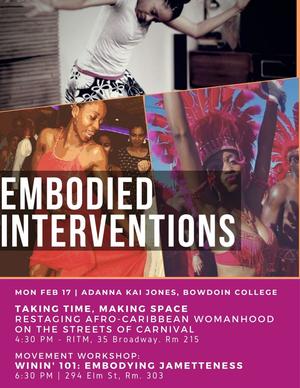
What is the intellectual work of dance? The answer: plenty.
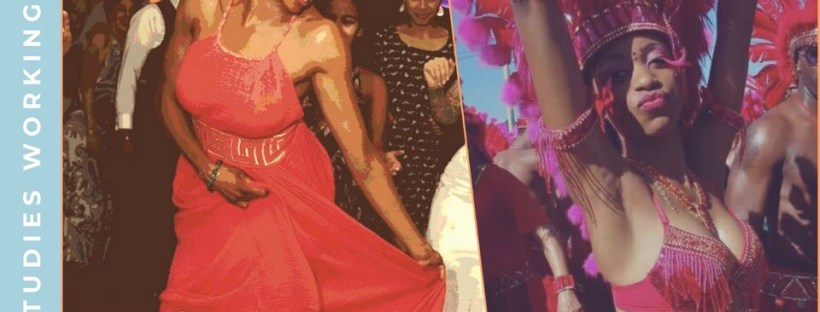
Caribbean “winin’” all at once teaches us about history, community, resistance, joy, sexuality, and various kinds of intimacies. And, physical and emotional endurance. Through her teaching and scholarship, Professor Adanna Kai Jones focuses on Caribbean dance and identity politics within the Diaspora, paying particular focus to Carnival and the rolling hip dance known as winin’. In a two-part event on February 17, she kicked off the Embodied Interventions series with her talk “Taking Time, Making Space: Restaging Afro-Caribbean Womanhood on the Streets of Carnival” which explored the masquerade “Whitewash”—a processional performance presented by New Waves! NY at the 2017 annual West Indian-American Day Carnival of Brooklyn. The second part of her offering was a movement workshop “Winin’ 101: Embodying Jametteness,” in which she taught participants about the bodily logic behind winin’ and introduced participants to the deep histories of this dance culture, paying particular attention to the late-19th Century jamette figure of Trinidad.
From the beginning of her talk in the seminar room of the Center for Race Indigeneity and Transnational Migration, Dr. Jones had participants engaged in embodied research practices. As she explained the variety of approaches to winin’ and hip rolling, she had us get out of our chairs and into our bodies so that we could feel and see the difference between the smooth circles of Trinidadian wine, choppier feeling of a Jamaican dagger, and the shuffling steps that propel the Carnival parade forward. For many, this was the first time they had been asked to get up and dance at an academic talk. A critical dance studies scholar, Jones’ work is based on deep study and practice of the dance form, ethnographic research, and archival work. The dance is both object and research method, and it is through dance that she helped us all understand questions or power, gender, race, and cultural resilience in the Caribbean and its diaspora. Jones’ talk explored a particular Carnival mas performance that took place in 2017 at the annual West Indian-American Day Carnival of Brooklyn, but in order to understand the importance of this event, Jones’ has us travel through space and time to understand the role of the wine and Carnival characters throughout Trinidad’s history and in the diaspora.
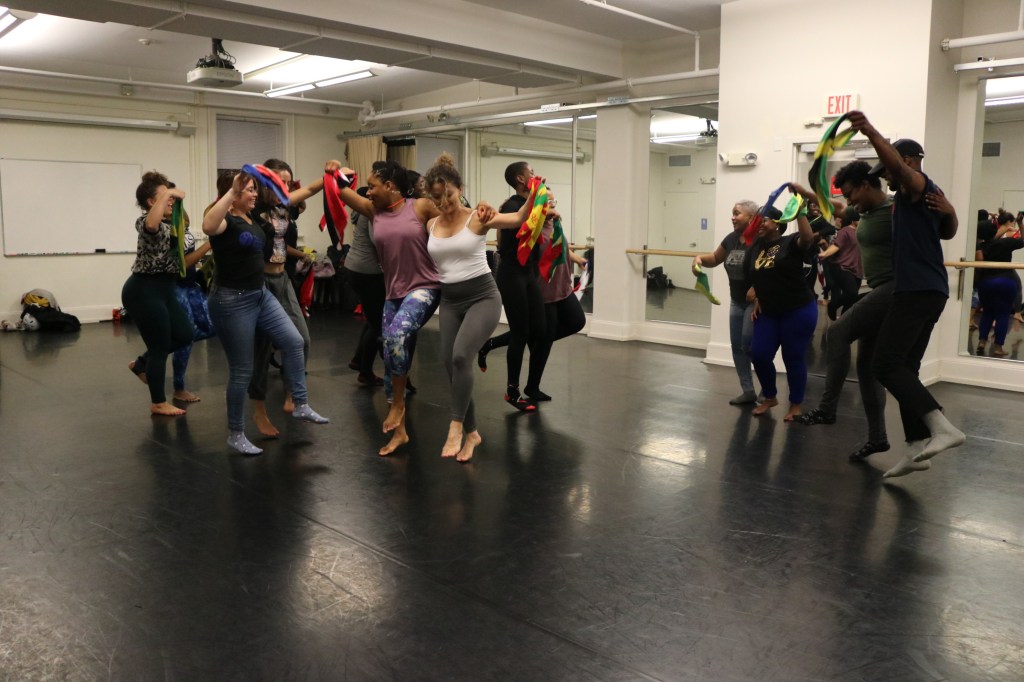
In the dance class that followed, we deepened our understanding of what Carnival feels like. Jones’ movement workshop cultivated an understanding of the form and its power that was only possible through embodied practice…
 Teanu Reid